
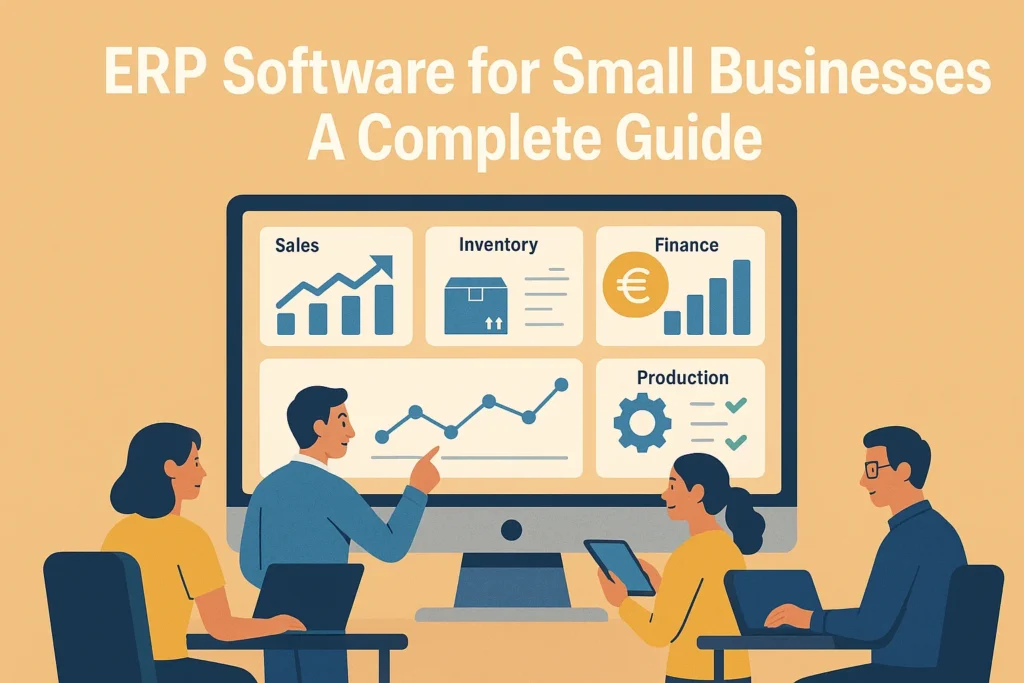

Small companies rarely suffer from a lack of effort; they struggle with fragmented tools. An order might begin in email, pass through a messaging thread, hit a spreadsheet for pricing, and end in a separate accounting package. Every handoff introduces delays and errors. ERP Software consolidates finance, sales, inventory, purchasing, production, and customer data into one platform, allowing owners to operate with clarity and speed.
The payoff is not just fewer clicks. When your demand, supply, and cash position are visible on one screen, you can promise delivery dates confidently, accept or reject rush orders with reasons, and schedule staff around actual bottlenecks. Leaders stop debating whose spreadsheet is correct and start discussing which constraint to elevate next.
- Unified data: one version of truth across departments.
- Process discipline: configurable workflows reduce ad-hoc steps.
- Faster decisions: dashboards provide timely, drill-down insights.
- Lower costs: automation replaces manual rework and duplicate entry.
- Customer experience: accurate promises, on-time delivery, and proactive service.
- Compliance: GST, e-invoices, and audits become routine rather than heroic.
Core Modules in ERP Software for Small Businesses
Although vendors vary, most small-business suites share a familiar backbone. Finance manages the chart of accounts, AR, AP, and cash. Sales and CRM capture leads, quotes, and orders. Purchasing coordinates suppliers, approvals, and receipts. Inventory tracks stock levels, locations, and valuation. For product companies, light manufacturing supports bills of materials, work orders, and basic scheduling. Service teams log tickets, contracts, and field activity.
A good test for completeness is to trace one customer order from lead to ledger. Can you create a quote, convert it to an order, reserve stock, generate a delivery challan, ship, invoice, collect payment, post to GL, and see profitability by product? If that chain feels smooth in a demo, the platform is likely mature enough for your first phase.
The table below summarises typical modules and benefits.
| Module | What it covers | Why it matters |
|---|---|---|
| Finance | GL, AR, AP, cash, fixed assets | Keeps books accurate and compliant |
| Sales & CRM | Leads, quotes, orders | Improves win rates and forecast accuracy |
| Purchasing | Suppliers, POs, receipts | Prevents stock-outs and overbuying |
| Inventory | Items, locations, costing | Controls working capital |
| Manufacturing | BOMs, work orders, routing | Enables on-time, quality production |
| Service | Tickets, SLAs, field work | Drives retention and upsell |
Do not overlook reporting. Beyond statutory compliance, you want role-based dashboards: owner, finance controller, storekeeper, production planner, and sales lead. The best systems allow drilling from a KPI to the transaction line, so a variance never sits unexplained.
Implementation Approach: Crawl, Walk, Run
Successful projects begin with focus. Rather than turning on everything, start with a minimal scope that solves painful problems and builds confidence. Many teams go live with finance, inventory, and order processing first, then layer advanced capabilities—approvals, mobile picking, simple MRP—once users are comfortable. Treat the rollout like product adoption: short cycles, clear outcomes, and steady training.
- Define two or three business goals tied to metrics such as on-time shipment, inventory accuracy, or DSO.
- Clean and map master data before migration; fix duplicates and standardise units.
- Configure, run a conference-room pilot with real documents, and capture feedback.
- Train champions in each department and document SOPs with screenshots.
- Go live in phases and hold daily stand-ups for two weeks to stabilise.
Change management is the hidden project. People are rightfully proud of the creative workarounds they used to keep the lights on. Respect that ingenuity while replacing it with repeatable process. Celebrate early wins publicly: a faster monthly close, fewer stock discrepancies, or the first error-free audit. Momentum is a strategy here.
Set clear roles for the project: an executive sponsor to remove blockers, a business lead to define process, and a technical lead to manage data and integrations. Create a shared glossary so everyone means the same thing by words like order, shipment, invoice, and fulfillment. When language aligns, configuration aligns faster.
Costs, Licensing, and Total Value
Cloud subscriptions usually scale per user or per company tier, with add-ons for advanced modules or transactions. Beyond licenses, budget for implementation help, data cleanup, integrations, and change management. Expect ongoing costs for support and minor enhancements. The payback often arrives through fewer stock discrepancies, faster invoicing, reduced days sales outstanding, and better purchasing.
Estimate ROI by listing hard and soft benefits. Hard savings include lower write-offs, reduced courier re-shipments, and fewer overtime hours. Soft benefits include better morale and easier onboarding. When leadership can trust the numbers, they negotiate and avoid surprises. Keep a baseline before the project so improvements are measurable.
Beware of hidden costs. Excessive customisation looks attractive but becomes a maintenance tax. Prefer configuration over code, and ask for examples of how other customers solved similar needs natively. Negotiate implementation in milestones with acceptance criteria so spending follows delivered outcomes. Finally, keep a contingency of ten to fifteen percent for surprises; data always hides them.
“What gets measured gets managed—and ERP makes the measuring automatic.”
Real-World Case Study: Dhanush Foods
Dhanush Foods, a five-year-old snack manufacturer in Pune, sold through distributors and online marketplaces. Orders escalated quickly, but the team juggled Excel, WhatsApp, and a separate billing app. Stock-outs of high-turn SKUs and delayed GST filings began hurting cash flow. Customer service kept apologising for late shipments, while production overmade slow movers because forecasts were guesswork.
They implemented a cloud ERP over eight weeks with a regional partner. Phase one covered items, multi-location inventory, purchase approvals, GST-ready finance, and marketplace order import via an API. Barcoded bins were introduced in the main store, and a simple reorder point was set per SKU. Within three months, inventory accuracy rose from 86% to 98%, late shipments dropped by 40%, and monthly close time shrank from nine days to four. Crucially, reorder points prevented lost sales during festive peaks.
Two human changes mattered most. First, production meetings moved from anecdotes to dashboard reviews, where yesterday’s variances were investigated immediately. Second, finance and supply colleagues agreed on a single item master and stopped entertaining back-door requests to create look-alike codes. Small disciplines compounded into predictable throughput.
Twelve months after go-live, Dhanush Foods introduced basic demand planning. The planner compared historical sales with upcoming promotions and used min-max rules by location. Service levels for A-class SKUs improved to 97%, while overall inventory value fell by eight percent because slow movers were pruned. The team now reviews a one-page scorecard every Friday: service, schedule adherence, inventory turns, and cash. The ritual keeps the system honest and the business calm.
Making ERP Software Stick After Go-Live
Technology success is culture success. Keep a backlog of improvements, run monthly KPI reviews, and continue role-based training. Use dashboards as the morning ritual so issues surface early. Establish data ownership—someone accountable for items, pricing, suppliers, and customers. When new hires join, onboarding must include both the process and the system, turning ERP into muscle memory rather than a special project.
- Guard the item master: strict naming, units, and categories.
- Schedule quarterly health checks on slow queries and unused fields.
- Promote super-users who can build reports without IT tickets.
- Tie bonuses to measurable process outcomes instead of activity volume.
- Review permissions twice a year to maintain least privilege.
Finally, keep evaluating fit. Your company will evolve; the system should, too. Most vendors release quarterly updates—assign someone to read notes, test in a sandbox, and decide what to adopt. A two-hour review every month preserves momentum and protects your original investment.
As the system stabilises, expand your analytics. A data warehouse or the ERP’s embedded BI can show cohort retention, vendor performance, or margin by channel. Start simple: a few trusted metrics. Share them on a screen in the office. Transparency changes behaviour. Daily.
Conclusion. For small businesses, ERP is not about heavy bureaucracy; it is about repeatability, transparency, and speed. With a phased rollout, disciplined data, and vendor fit, even lean teams can capture the advantages once reserved for large enterprises. Choose a narrow first win, prove value, and keep iterating—the system will grow with you, one predictable process at a time.