
Finance teams carry a heavy responsibility: producing accurate numbers fast enough to guide the business, while safeguarding controls and cash. Manual spreadsheets and disconnected systems slow that mission, add risk, and hide the story behind the numbers. Enterprise resource planning brings those moving parts together, turning transactions into trustworthy insights.
This article explains how ERP Software enhances financial management and reporting. We will focus on the capabilities that matter most to CFOs and controllers, from the monthly close and consolidation to rolling forecasts, audit readiness, and real-time performance dashboards. Along the way, we will highlight practical ways to improve adoption and keep costs under control.
If you are exploring a new system or simply want to unlock more value from your current platform, use this guide to align finance, operations, and IT on what “great” looks like and how to get there.
Why Finance Leaders Turn to ERP Software
ERP systems unify accounting, procurement, inventory, projects, and payroll within a single ledger and data model. That common foundation eliminates endless reconciliations and creates a dependable view of cash, cost, and revenue. The result is faster cycles, cleaner audits, and leaders who can act on facts rather than estimates.
- Single source of truth: Journal entries, subledgers, and operational data share master records for customers, suppliers, items, and cost centers.
- Process standardization: Quote-to-cash and procure-to-pay follow governed steps that reduce leakage and improve compliance.
- Real-time visibility: Dashboards, alerts, and embedded analytics spotlight exceptions the moment they occur.
- Audit trail by design: Every change is time-stamped and attributed to a role, simplifying both internal and external audits.
“Closing the books quickly is important; understanding what the numbers are saying is transformational.”
Modern platforms also help finance shift from historian to navigator. With scenario modeling and driver-based planning, teams spend more time explaining outcomes and less time cleaning data.
Core Financial Management Capabilities
Most organizations start with general ledger, accounts receivable, accounts payable, fixed assets, and cash management. From there, the platform can extend to tax, projects, revenue recognition, and advanced allocations. The key is how these modules work together.
- General ledger and dimensions: Multi-entity, multi-currency ledgers with flexible dimensions enable precise analysis without bloating the chart of accounts.
- Accounts receivable: Automated invoicing, credit limits, and collections worklists shorten DSO and reduce write-offs.
- Accounts payable: Three-way match, vendor portals, and payment runs streamline approvals and strengthen cash control.
- Fixed assets: Capitalization rules, depreciation books, and asset transfers keep financial and operational views in sync.
- Cash and bank management: Automated reconciliations and daily liquidity views strengthen treasury decisions.
Integration with purchasing, inventory, and sales ensures that financial postings originate from controlled operational steps. That alignment removes the end-of-month scramble to piece together the big picture.
ERP Software Reporting and Analytics
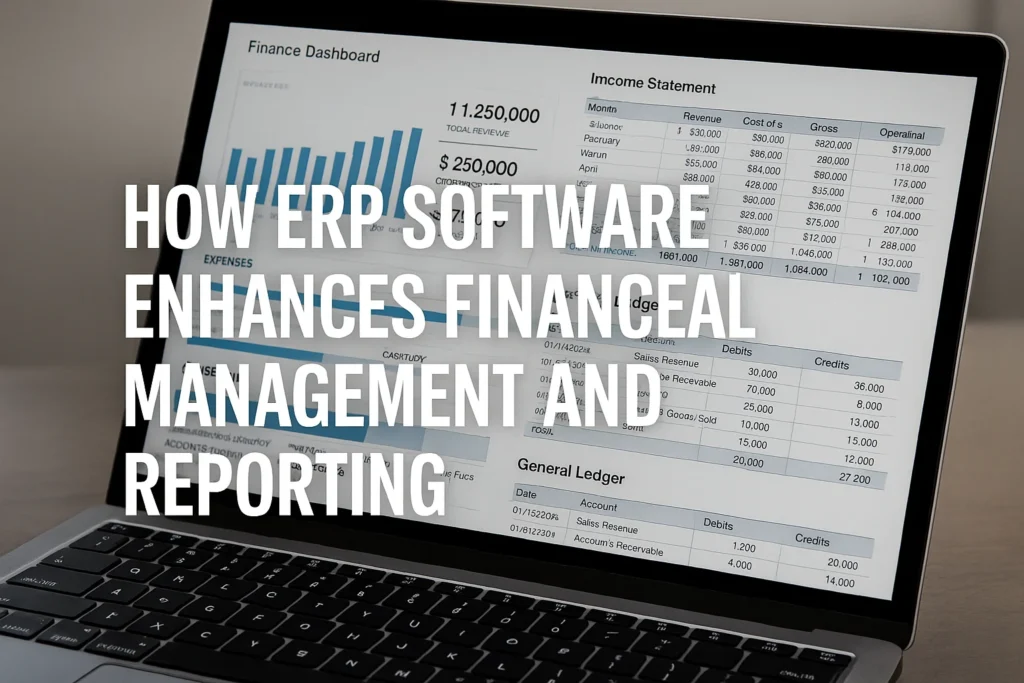
Reporting is where value becomes visible. ERP Software centralizes transactions and master data, enabling standard financial statements and operational drilldowns from the same source. Instead of emailing spreadsheets, teams work from governed models that update in real time.
| Reporting Area | What Improves | Why It Matters |
|---|---|---|
| Financial statements | Consistent P&L, balance sheet, cash flow | Executives trust one version of results |
| Operational drilldowns | Line-item and transaction-level traceability | Faster root-cause analysis and cost control |
| Budget vs. actuals | Automated variance tracking by driver | More accountable planning and spending |
| Forecasting | Scenario modeling with live actuals | Decisions reflect the latest demand and cost |
| Compliance | Audit-ready trails and segregated duties | Lower risk and smoother audits |
With governed metadata, finance can publish board-ready packs without manual consolidation. Embedded analytics reduce the distance between a KPI and the transactions that shaped it, which accelerates learning and action.
Data Governance, Controls, and Compliance
Sound governance prevents surprises. Role-based access, approvals, and segregation of duties are built into leading platforms. Master data workflows ensure that new suppliers, items, and customers are vetted before they influence the ledger.
- Define who can post, approve, or reverse transactions for each process stage.
- Use workflow to enforce thresholds for discounts, write-offs, and capital purchases.
- Apply retention policies and document links to support audits and tax filings.
- Leverage change logs to surface unusual activity and strengthen detective controls.
When controls are embedded in daily work, compliance becomes a byproduct of doing the job right. That shift saves time and reduces audit fees, because evidence is captured as transactions occur.
Integrations and Automation That Reduce Manual Work
Finance accuracy depends on timely data from the broader business. Integrations connect the ERP ledger to CRM, ecommerce, banking, payroll, manufacturing, and data warehouses. Standard APIs and event streams move information quickly and safely.
Automation augments those connections. Examples include vendor invoice OCR and matching, rules-based revenue recognition, automatic accruals for goods not invoiced, and bank statement imports with machine learning suggestions. Each eliminates a spreadsheet and reduces cycle time.
Do not overlook collaboration. Comment threads on transactions, sharing links for review, and task lists for close activities keep everyone aligned without additional meetings.
From Close to Insight: Operating With a Modern Rhythm
The finance calendar becomes more predictable with a well-tuned platform. Many teams adopt a “continuous close” mindset that reconciles daily and leaves month-end for adjustments and analysis. That rhythm supports weekly flash reports and confident mid-month decisions.
- Daily reconciliations: Bank, subledger, and inventory movements cleared each day.
- Weekly flash: Revenue, margin, and cash dashboards for leadership standups.
- Month-end: Accruals and allocations, then narrative reporting within five days.
- Quarterly: Deeper trend reviews and scenario planning for the next two quarters.
With consistent cadence, finance partners more closely with sales, supply chain, and HR to shape outcomes rather than simply record them.
Case Study: Regional Distributor Accelerates Close and Forecasts
Background. NorthRiver Supply, a fast-growing distributor with eight branches, ran separate accounting and inventory tools. Intercompany reconciliations consumed days, and leaders lacked visibility into branch profitability. The CFO sponsored an ERP rollout centered on unified GL, AR/AP, inventory, and bank reconciliation.
Implementation. The team standardized the chart of accounts, introduced dimensions for branch and product family, and enabled automated three-way match in payables. Bank feeds and rules shaved hours from reconciliations. A driver-based forecasting model tied sales pipeline, inventory turns, and expense run rates into a rolling 12-month forecast.
Results. First-quarter after go-live, the monthly close dropped from nine to five business days. Branch-level P&Ls exposed freight leakage that was corrected through new quoting rules. Cash forecasting improved accuracy from “best guess” to within three percent variance, enabling earlier debt paydown and interest savings.
Building the Business Case and Measuring Value
Strong ROI does not come from software alone; it comes from eliminating rework and improving decisions. Build your case with measurable targets and owners. Typical benefits appear across five dimensions: working capital, productivity, risk, growth capacity, and IT simplification.
- Working capital: Lower DSO, healthier inventory, and smarter payment timing.
- Productivity: Fewer manual reconciliations and faster report production.
- Risk: Stronger controls, fewer write-offs, and cleaner audits.
- Growth capacity: Ability to add entities, products, or channels without chaos.
- IT simplification: Retire brittle point solutions and consolidate integrations.
Track benefits as you would a project portfolio. Establish baselines, set quarterly checkpoints, and publish a simple scorecard. Celebrate wins and fix bottlenecks quickly.
Conclusion
Practical tips for adoption. Treat the first months after go-live as an extension of the project rather than a finish line. Create a lightweight finance operations council that meets weekly to triage issues, prioritize small enhancements, and prevent workarounds from creeping back in. Encourage teams to use saved searches, scheduled reports, and alert subscriptions instead of downloading data to spreadsheets. Small habits compound, especially when new hires learn the preferred way on day one and managers reinforce it with regular coaching and peer reviews.
Another useful step is to document how metrics are calculated and publish those definitions directly alongside dashboards. When everyone understands how gross margin, contribution margin, or customer lifetime value are derived, debates focus on actions, not numbers. ERP Software shines when its analytics are trusted; that trust grows when definitions are transparent and stable.
Finally, invest in a routine of post-close retrospectives. Ask a simple set of questions: What delayed us? Where did data fail quality checks? Which manual step could be automated next month? Capture answers in a backlog and burn it down steadily. This continuous improvement loop keeps the platform aligned with the business and protects the ROI you modeled in the first place.
When possible, assign clear owners for each metric and publish a monthly scorecard to the intranet; transparency encourages constructive competition and steady improvement. Keep goals visible daily.
Financial management thrives on clarity, speed, and trust. By centralizing transactions and codifying processes, ERP platforms create a foundation for accurate numbers and confident decisions. Reporting becomes timely, audit evidence is always at hand, and teams collaborate around shared facts.
When you pair disciplined governance with thoughtful automation, finance stops wrestling data and starts steering the business. Whether your next step is modernizing the close, improving forecasting, or building board-ready dashboards, the path is the same: standardize where it counts, connect the systems that matter, and let ERP Software turn activity into insight.