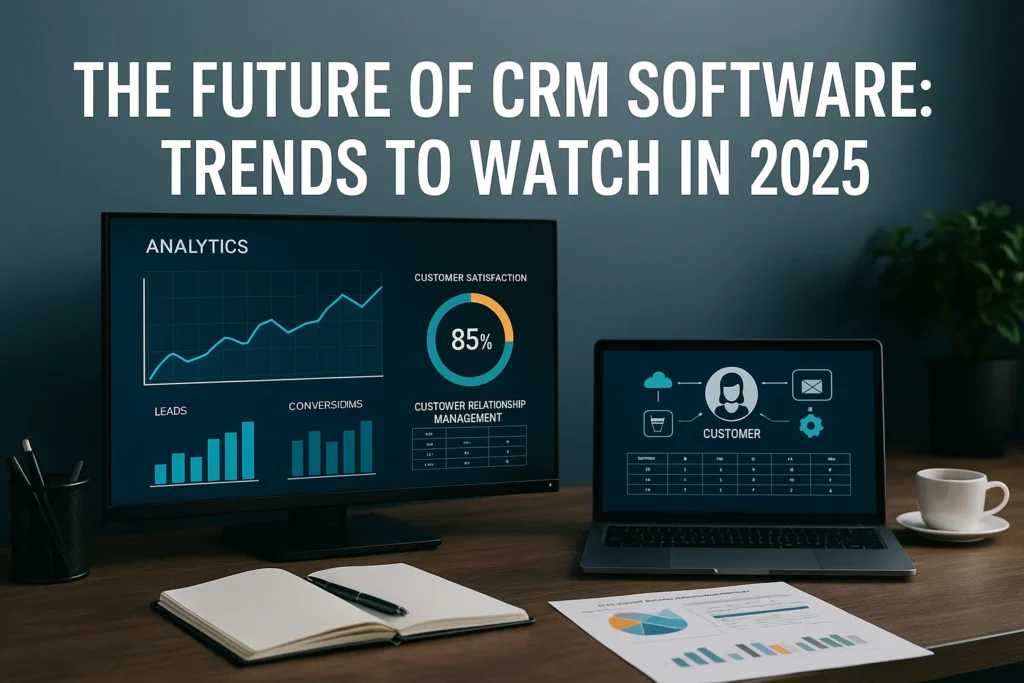

The customer relationship management (CRM) market in 2025 is shifting from “systems of record” to “systems of action.” Marketers, sales teams, and support leaders want outcomes they can prove: higher conversion, lower churn, faster cycles, and cleaner data. The next wave of CRM software is therefore defined by automation, intelligence, and interoperability that reflects how revenue teams actually work today—across channels, devices, and partners.
Three macro forces are accelerating this change. First, AI is becoming native to every workflow, from lead scoring to copywriting to revenue forecasting; second, privacy regulation and the loss of third-party cookies are forcing consent-first data strategies; and third, revenue operations are consolidating data from ERP and finance systems to close the loop between pipeline and profit. Together, these forces are turning CRM into an operating layer for growth.
This article explores the most important trends to watch in 2025, practical steps to get value now, and a compact case study that shows the impact when teams align process, data, and tools. If you’re evaluating platforms, use the quick-hit checklists and the comparison table to pressure-test vendor claims.
AI-Native CRM and Predictive Engagement
By 2025, AI isn’t a bolt-on; it’s embedded in the CRM’s core services: identity resolution, routing, sequence timing, content suggestions, and forecasting. The best systems learn from every touch—email opens, WhatsApp replies, demo attendance—to predict the next best action and personalize at scale. Crucially, AI must be transparent and controllable: admins need guardrails, editable prompts, and clear attribution for generated content.
- Practical win: Use behavioral signals (site intent, product usage, invoice events) to trigger outreach within minutes, not days.
- Setup tip: Train models on conversion-quality, not just response rates, so the AI optimizes for revenue, not vanity metrics.
- People impact: Reps spend more time on high-intent conversations while assistants draft recaps, tasks, and follow-ups.
“When the model started timing outreach around product milestones, our reply rate doubled and the pipeline became more predictable.”
Customers reply where they live. In many markets that’s WhatsApp; in others, RCS or SMS. Voice assistants are also maturing for scheduling, password resets, and status checks. The CRM of 2025 must unify these threads without losing context or consent, and it should price fairly for high-volume conversational traffic. Measure more than sends: track first-response time, resolution rate, and revenue influenced by conversation. Use intent detection to route complex cases to humans and keep bots focused on deterministic tasks that have clear boundaries.
Expect vendors to ship “copilot” experiences across sales and service, but don’t conflate demos with durable value. Insist on auditable outcomes, prompt governance, and roll-back plans for any AI that changes customer-facing text. Ask for confusion-matrix style evidence on models that auto-close tasks or qualify leads, so you can tune thresholds before scale.
Privacy, Consent, and the Cookieless Reality
Consent banners and preference centers move from compliance theater to strategic assets. With fewer third-party signals, first-party data quality decides targeting accuracy and lifecycle personalization. Modern CRMs need native consent objects, field-level lineage, and easy exports for DSRs. Teams should design outreach that can thrive without cookies: server-side tracking, hashed identifiers, and content that earns logins.
- Map the legal basis for each data use: contract, consent, legitimate interest—then reflect that in fields and policies.
- Instrument server-side events and enrich with marketing attribution that doesn’t rely on cross-site cookies.
- Offer granular opt-downs (less often, channel choice) to reduce unsubscribes without losing the relationship.
The winners treat privacy as product quality: correct, timely, permissioned data builds trust and unlocks the richest personalization.
How ERP Software Shapes CRM Convergence
Revenue teams can’t optimize what they can’t reconcile. In 2025, CRM systems increasingly sync invoices, entitlements, and fulfillment signals from ERP Software so sellers can see value realization, not just deal size. That enables new plays: proactive renewal nudges when usage is soft, cross-sell cadences aligned to inventory, and service gestures triggered by delayed shipments.
Technically, this means event-driven integration: when an order ships, when a payment fails, when a license expands—those become CRM events. You’ll need common IDs, late-arriving data handling, and deduplication rules that protect master records. The payoff is a single revenue truth that ties marketing spend to gross margin.
Case Study: Mid-Market SaaS Aligns CRM with ERP
Context: A 220-employee SaaS company relied on a CRM for leads and deals, but renewals lagged and upsell timing was guesswork. Finance ran on a separate ERP. Reps didn’t know which customers were under-utilizing seats or had unpaid invoices.
Intervention: The team created event streams from ERP Software: invoice paid, payment failed, seats activated, usage thresholds crossed. They enriched the CRM with these events, built playbooks (collections, cross-sell, save motions), and trained an AI model on renewal probability.
Outcome in 90 days: Past-due follow-ups dropped by 42%, renewal forecast error shrank by 18%, and targeted upsell emails lifted expansion bookings by 14%. Perhaps more importantly, sales and finance now shared a definition of “healthy account.”
ERP Software + CRM: Unified Data Pipelines
Beyond point-to-point syncs, organizations are building a shared customer lake with policies for freshness, access, and retention. ERP Software emits financial reality, CRM emits engagement reality, and analytics warehouses reconcile the two. The practical architecture is simple: message bus for events, warehouse for history, reverse ETL for activation, and the CRM as the human interface for action.
Governance matters. Create data contracts for objects like Account, Order, and Subscription, and enforce them at the pipeline level. When marketing creates a new field, finance should know how it rolls up to revenue recognition so reports don’t drift. Build schema checks into CI and alert on contract breaks.
Low-Code Automations and Composable Stacks
Procurement teams prefer modularity over monoliths. Expect 2025 stacks to combine a core CRM with a handful of specialized apps—data enrichment, onboarding, conversation intelligence—glued together with low-code automation. Visual builders let operations ship fast while engineering enforces standards through reusable components.
To avoid chaos, standardize around: naming conventions for triggers, versioned workflows, centralized secrets, and observability (latency, failure rate, dead-letter queues). Build a library of approved recipes: lead capture to enrichment to routing, onboarding checklist to NPS, renewal notice to upsell path.
60-Day Rollout Plan
- Week 1–2: Pick a narrow scope (renewals or trial conversion). Define north-star metrics and owners. Inventory data sources.
- Week 3–4: Stand up event collection and server-side tracking. Draft data contracts and consent mapping. Prototype AI scoring.
- Week 5–6: Build low-code workflows for routing, alerts, and nudges across email and WhatsApp. Create a feedback loop with reps.
- Week 7–8: Launch an A/B pilot. Compare revenue outcomes, not just engagement. Document lessons and de-risk scale-up.
Buyer’s Checklist for 2025 Platforms
When you evaluate vendors, go beyond feature grids. Stress-test them with scenarios that mirror your real world. Use the questions below during proofs-of-concept and ask vendors to demonstrate outcomes with your data, not canned demos.
- Can the AI show training data sources and give edit control for prompts and tone?
- Does consent flow through every integration, including exports to ad platforms?
- Is there a native event model so ERP Software signals can trigger CRM automations?
- How are failures surfaced? Do you get dead-letter queues, retries, and structured logs?
- What’s the total cost of ownership once you price messaging, storage, automations, and seats?
Use this compact table as a cross-vendor yardstick:
| Trend | Why it matters | 2025 action |
|---|---|---|
| AI-native workflows | Faster, higher-quality outreach and forecasts | Deploy copilots with prompt governance |
| Consent-first data | Legal, durable personalization without cookies | Implement preference centers and server-side events |
| ERP-CRM convergence | Closed-loop revenue visibility | Adopt event-driven sync and shared IDs |
| Composable automation | Faster iteration, lower lock-in | Standardize builders, logging, and secrets |
Finally, demand transparent pricing, export paths for all objects, and clear SLAs. These basics often predict whether the partnership will scale smoothly during onboarding.
Conclusion
The future of CRM software in 2025 is not defined by a single killer feature but by how well platforms turn live data into trusted, orchestrated action. AI raises the ceiling on what one seller or marketer can do; privacy and consent raise the floor for what’s acceptable; and ERP-CRM convergence closes the loop so growth is profitable, not just fast. Teams that pilot narrowly, instrument carefully, and design for interoperability will out-learn the market and ship compounding improvements, quarter after quarter.
If you remember one thing, remember this: a modern CRM is the nerve center for revenue, but it becomes truly valuable only when it is connected, observable, and accountable. Measure what matters (cash, retention, expansion), keep humans in the loop for judgment calls, and let automation handle the rest. The organizations that embrace these principles in 2025 will move faster, waste less, and build relationships that compound.