
Modern businesses operate in a landscape defined by volatility, digital-first customer expectations, and razor-thin margins. To keep up, leaders need systems that centralize data, automate routine work, and deliver real-time insight without heavy infrastructure costs. Cloud ERP brings all of those capabilities together, blending financials, operations, supply chain, and people processes into a single, secure platform that scales on demand.
While traditional on-premise suites once dominated, subscription-based platforms have matured dramatically. Today’s solutions are easier to implement, simpler to maintain, and far more adaptable to industry-specific needs. The result is faster value and lower risk for organizations of every size—from ambitious startups to complex enterprises with global footprints.
In this guide, we unpack the top benefits of adopting Cloud ERP Software for modern businesses. You will see how the right platform reduces complexity, tightens control, and accelerates growth, all while supporting a future-proof operating model.
Unified data and real-time visibility
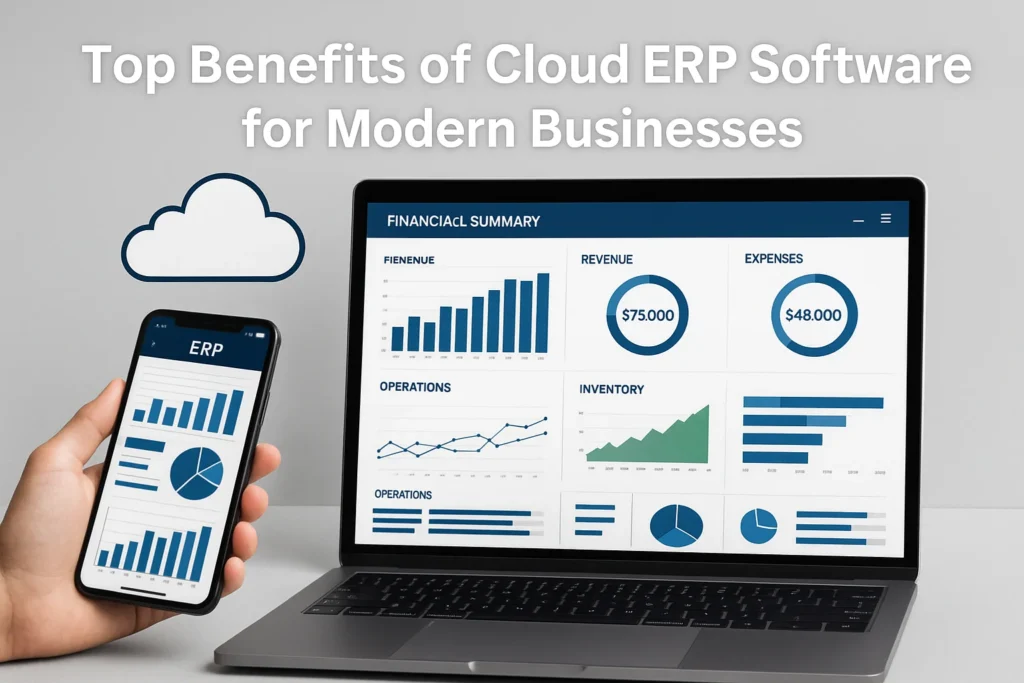
A defining strength of cloud platforms is the way they unify data. When sales, finance, procurement, production, and service teams rely on one source of truth, reports stop contradicting each other and decisions become data-driven rather than opinion-driven. Executives get dashboards with up-to-the-minute revenue, inventory, cash, and staffing metrics. Managers drill down from KPIs into transactions with a click, spotting anomalies early and correcting course before small issues become costly problems.
This visibility also shortens planning cycles. Rolling forecasts, demand plans, and cash projections update automatically as new orders arrive or suppliers delay a shipment. Instead of quarterly budget battles, finance and operations collaborate continuously. With the right access controls, field staff can view only what they need, while auditors and leadership see complete histories for compliance and oversight.
Agility through configuration, not code
Cloud ERP platforms prioritize configuration over heavy customization. Teams can add entities, adjust approval chains, or introduce new products via no-code tools and guided wizards. That means process changes roll out in hours or days, not months. When regulations shift or a new business model emerges—say, subscription billing or usage-based pricing—administrators adapt screens, rules, and workflows without sending a lengthy brief to engineering.
- This agility is crucial in volatile markets. Organizations can pilot changes, gather feedback, and iterate quickly.
- Sandboxes mirror production data for safe experimentation. Because updates are centralized, everyone benefits from improvements simultaneously, reducing version drift and keeping the organization aligned.
Lower total cost of ownership
The financial case for cloud is straightforward: no servers to purchase, less networking complexity, and fewer specialized admins to keep the lights on.
| Subscription pricing converts capital expenditure into predictable operating expense. |
| Vendors bundle hosting, backups, security patches, and performance monitoring into the service, simplifying the IT portfolio and freeing talent for higher-value initiatives like analytics or automation. |
Costs outside of IT shrink too. Standardized processes reduce rework and duplicate data entry. Self-service reporting saves analyst hours. Built-in integrations minimize the need for bespoke middleware. Over time, the combination of lower maintenance and improved productivity compounds, delivering a compelling return on investment that is visible in both the P&L and the balance sheet.
Security and compliance by design
Many teams assume on-premise equals safer, but leading cloud providers typically exceed the protections most companies can achieve alone. Data centers are hardened, monitored, and geographically redundant. Encryption safeguards data at rest and in transit. Fine-grained role-based access controls, multi-factor authentication, and audit trails restrict who can view or change sensitive information. Certifications such as ISO, SOC, and industry-specific frameworks help prove good governance.
Cloud also simplifies compliance work. Instead of manually tracking regulatory changes and applying patches, customers inherit security improvements from the vendor’s shared responsibility model. Automated logs and reports accelerate audits. Data residency options and retention policies help meet regional rules without splintering the system into risky local workarounds.
Operational excellence with ERP Software automation
Modern ERP Software excels at streamlining core operations. Automated three-way match removes friction from payables. Rule-based invoicing speeds cash collection. MRP aligns purchasing with production plans to avoid both stockouts and excess inventory. Quality workflows document inspections, nonconformances, and corrective actions. For services organizations, resource scheduling, project accounting, and time capture keep delivery teams focused and utilization high.
Automation is not only about speed; it is about consistency.
When rules are modeled in the system, the “right way” becomes the default way. Exceptions bubble up for human attention, while the majority of transactions flow through unattended. That raises the floor of performance and unlocks headroom for teams to invest in innovation and customer value rather than wrestling with spreadsheets.
Case study: a mid-market manufacturer
Consider a mid-market appliance manufacturer operating three plants and selling through distributors and online. Before moving to the cloud, finance closed the month on day twelve, planners lacked confidence in demand signals, and service teams fielded calls blind to parts availability. After adopting Cloud ERP Software, the company standardized item masters, automated intercompany transfers, and integrated its web store and carrier network.
Within two quarters, the average days sales outstanding dropped by five, reducing working capital needs. Inventory accuracy improved to 98%, enabling a leaner safety stock posture. The service desk now receives automatic alerts when warranty parts ship, so agents can educate customers proactively and avoid repeat calls. Perhaps most importantly, the executive team reviews a live margin bridge each week, drilling into mix, price, and yield to guide production and marketing decisions with shared facts.
Scalability and global readiness
Because infrastructure is elastic, seasonal peaks or unexpected demand surges do not require weeks of capacity planning. Additional users, warehouses, or subsidiaries can be added with minimal friction. Multi-entity, multi-currency, and multi-tax support allow finance to consolidate results accurately while maintaining local compliance. Embedded localization packs handle languages, fiscal calendars, and statutory reporting across regions, which is particularly valuable as companies expand through acquisitions.
This scalability supports experimentation. A new direct-to-consumer channel or a pop-up distribution center can be launched and measured quickly. If a pilot succeeds, you scale it. If it fails, you shut it down without being stuck with idle servers or shelfware licenses.
Seamless integrations and an open ecosystem
No platform does everything. Cloud ERP’s advantage is an ecosystem of prebuilt connectors, REST APIs, and event frameworks that allow best-of-breed applications to coexist gracefully. CRM, e-commerce, transportation management, HRIS, point-of-sale, and data warehouses sync bi-directionally. Webhooks and iPaaS tools orchestrate cross-app workflows, while low-code builders let business users create light-weight apps that extend the core without compromising governance.
The payoff is end-to-end flow. A web order triggers a credit check, reserves inventory, books revenue, and schedules fulfillment automatically. Data lands in the warehouse for analytics, while customer service sees shipment status in the same workspace used for returns. With the ecosystem doing the plumbing, teams focus on outcomes rather than integration chores.
Change management and user adoption
Technology projects succeed or stall based on people. Effective change management starts early: mapping stakeholder groups, defining the why, and designing training for each role. Champions help local teams translate new workflows into daily habits. Because cloud updates arrive regularly, adoption is an ongoing practice rather than a one-time event; release notes become opportunities to simplify and improve.
Measure adoption with leading indicators—login frequency, completion of guided learning, and usage of key transactions—alongside lagging KPIs such as cycle time or cost variance. Recognize progress publicly to reinforce momentum. Keep governance light but clear: a cross-functional council can prioritize enhancements and ensure process discipline without smothering agility.
How to evaluate vendors and plan the rollout
A structured evaluation frames tradeoffs transparently. Start by articulating outcomes: faster close, fewer stockouts, improved customer satisfaction, or compliance obligations. Score vendors against those outcomes, not just feature lists. Probe architecture: data model flexibility, API maturity, identity options, and analytics strategy. Validate security posture and uptime commitments. Ask for references with similar process complexity and integration needs.
For rollout, sequence value. Many firms adopt a “financials-first, operations-next” approach, but your path should reflect constraints. A phased deployment reduces risk and gives teams time to adapt. Establish a clean data foundation: chart of accounts, products, customers, suppliers, and locations. Invest in testing with real scenarios. Plan cutover rehearsals, and decide up front what historical data to migrate versus archive for audit access.
Conclusion: How ERP Software elevates the business
When cloud becomes the operating backbone, organizations shift from reactive firefighting to proactive steering. Leaders trust numbers, not hunches. Results become predictable and repeatable across teams.
Teams spend less time reconciling and more time improving. New ventures stand on the shoulders of reusable processes and integrations rather than reinventing the wheel. In a market where speed and resilience define winners, Cloud ERP is not merely an IT upgrade; it is a business model upgrade.
The takeaway for modern businesses is clear: align your roadmap with a platform that unifies data, automates execution, scales globally, and plugs into an open ecosystem. Treat change management as a core workstream, measure adoption relentlessly. Do that, and the benefits compound—quarter after quarter, year after year.
About the Author
Arjun Patel writes practical, vendor-neutral guides on ERP Software and digital operations. He focuses on clear outcomes, simple language, and real-world lessons from manufacturers, retailers, and service organizations across India and beyond.