
Choosing the right customer relationship management platform can feel like a maze. Vendors promise everything from lightning-fast deployments to predictive insights, yet the best CRM is the one that fits your workflows, data realities, and growth plans. The right decision empowers sales, marketing, service, and leadership to act on the same, trusted view of customers.
In this guide, you’ll learn a practical, step-by-step approach to evaluating CRM options with confidence. We’ll frame the process around real requirements, measurable outcomes, and a smooth path from implementation to adoption. Whether you’re upgrading from spreadsheets or replacing a legacy tool, this checklist will keep the focus on value—not vanity features.
Use the sections below to align stakeholders, score capabilities, and avoid common pitfalls. You’ll find a simple comparison table, a mini case study, and concrete evaluation criteria. By the end, you’ll be ready to shortlist vendors, negotiate clearly, and launch with momentum.
Understand Your CRM Use Cases and Teams
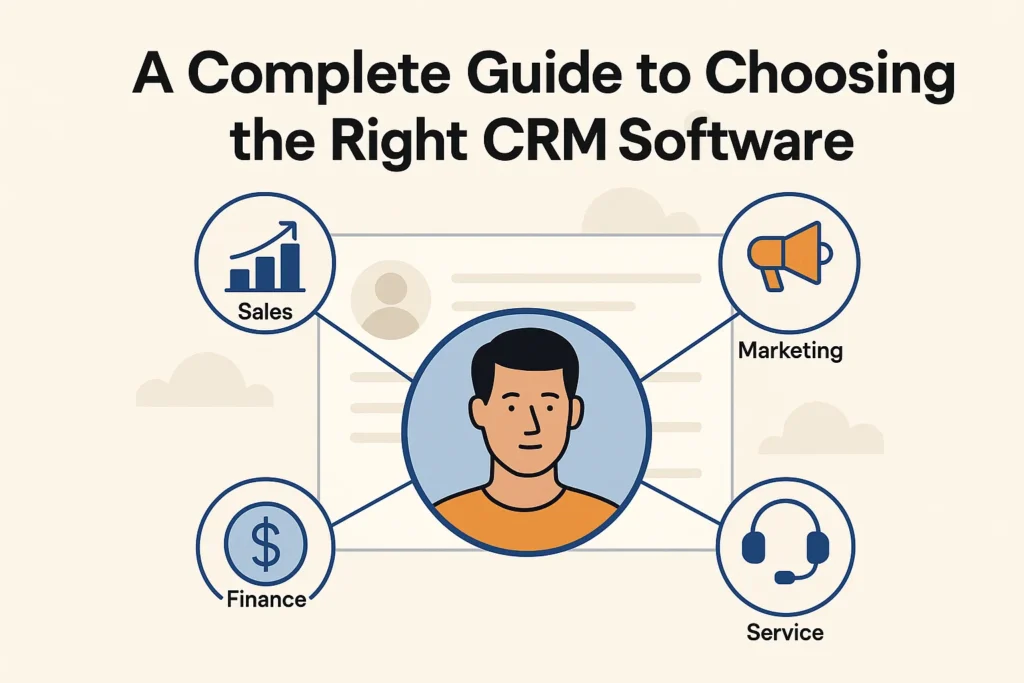
Start by mapping the outcomes you need across the customer lifecycle. Group them into sales pipeline, marketing automation, customer service, and analytics. Translate each outcome into a scenario: who does what, using which data, and what success looks like.
Create a cross-functional discovery document. Include sales managers, SDRs, marketers, support leaders, finance, and IT. For each role, capture top tasks, current pain points, and must-have capabilities. Limit the initial list to the forty or fewer items that truly move the needle.
Prioritize scenarios with a simple scale—critical, important, nice to have. Tie critical items to revenue, cost, risk, or compliance. This turns the selection into a business project, not a feature hunt, and gives your steering committee an objective way to compare vendors.
- Sales: qualify leads, update stages, forecast accurately.
- Marketing: segment audiences, nurture journeys, attribute pipeline.
- Service: triage tickets, route SLAs, surface knowledge.
- Finance: validate terms, credit status, and invoicing readiness.
- IT/Data: govern integrations, permissions, and quality rules.
“If a scenario doesn’t map to a measurable outcome, park it for later. Selection accelerates when every requirement earns its place.”
Data, Security, and Compliance Essentials
CRMs are only as good as the data they contain. Document your sources: web forms, product usage events, support tickets, billing systems, and third-party enrichment. Verify how records will be deduplicated, merged, and governed. Ask vendors to demonstrate identity resolution on your sample data.
Security requirements should be explicit. Define SSO standards, role-based access, field-level permissions, audit trails, and data residency. Confirm certifications such as ISO 27001 and SOC 2. If you operate in regulated markets, ensure GDPR and regional consent capture flows are native or extensible.
Plan for backup, retention, and lawful deletion. Assess vendor capabilities for sandboxing, change logs, and rollback. Build a data dictionary early, and decide who owns data quality metrics. Your future integrations and analytics depend on getting this foundation right.
- Confirm SSO against your identity provider and test role provisioning.
- Validate field-level security on PII and export controls.
- Review audit logs, admin delegation, and least-privilege defaults.
How CRM Connects to ERP Software for End-to-End Visibility
Most revenue gaps stem from broken handoffs between front-office and back-office systems. Your CRM should synchronize customers, products, pricing, quotes, orders, invoices, and payments with ERP Software so teams operate on a single version of truth.
During evaluation, insist on a live demo that flows from lead to cash. Watch how quotes become orders, how discounts sync to invoicing, and how credit holds or stockouts surface in the CRM. If the vendor relies on brittle exports, budget extra time and cost for middleware.
Decide where authority lives for each object. For example, finance may own billing addresses in ERP Software, while sales owns contact roles in CRM. Spell out conflict resolution rules and latency expectations—minutes for inventory updates, near-real-time for payment status, and daily for historical snapshots.
| Business Object | System of Record | Sync Frequency |
|---|---|---|
| Accounts & Contacts | CRM | Real-time |
| Products & Price Books | ERP Software | Hourly |
| Orders & Invoices | ERP Software | Real-time or near-real-time |
Evaluating ERP Software Integration Capabilities with Your CRM
There are three common paths: native connectors, iPaaS platforms, and custom APIs. Native connectors are fastest to launch but can be rigid. iPaaS offers mapping, retries, and monitoring. Custom builds maximize flexibility but demand strong engineering discipline and ongoing ownership.
Score each path against data volume, error handling, observability, and vendor support. Require an architecture diagram, including webhooks, retries, and idempotency. Ask how the solution will scale during month-end spikes or seasonal campaigns, and what happens when endpoints change.
Finally, model costs over three years. Include connector licensing, iPaaS runs, API overages, maintenance hours, and monitoring. Integration is a product, not a project; treat it with the same rigor you would any mission-critical system.
Deployment Models and Total Cost of Ownership
Cloud-native CRMs dominate for good reason: faster updates, elastic scale, and strong ecosystems. Still, consider your constraints. If you need on-prem or private cloud for sovereignty, confirm feature parity and roadmap commitments. Hybrid models can work, but only with crisp boundaries.
Build a TCO model that spans licenses, add-ons, storage, integrations, internal time, implementation partners, training, and change management. Price not only today’s seats, but expected growth over twenty-four to thirty-six months. Vendors will discount year one; your model should not.
Estimate adoption costs honestly. Budget for data cleanup, admin time, and enablement. Include the opportunity cost of slow rollouts. A less expensive license that delays value can be more costly overall than a premium tool that teams actually use.
User Experience, Automation, and AI
Great CRMs fade into the background. Reps should log calls, update deals, and create follow-ups in seconds. Test the mobile experience, offline behavior, and accessibility. Watch how the system reduces clicks, not adds them. If your users need a manual for every task, the design misses the mark.
Automation separates modern platforms from relics. Evaluate workflow builders, triggers, rules, and approvals. Check whether business users can own automations without writing code, and whether admins have guardrails and version control. Measure how quickly you can adapt processes as your business evolves.
AI belongs in the flow of work. Look for summarization of notes, intent classification, lead and churn scoring, conversation insights, and content suggestions. Demand explainability and bias controls. Most importantly, tie AI outputs to measurable outcomes—faster cycle time, higher win rates, or reduced escalations.
Change management is the quiet multiplier. Pair feature training with role-based playbooks, sample reports, and bite-sized videos. Recognize quick wins publicly, share before-and-after screenshots, and codify tips in an internal wiki. Appoint floor walkers for the first two weeks so questions never linger. When adoption is visible and celebrated, pipelines stay clean, cases close faster, and executive dashboards tell a story people trust.
Implementation Plan, Vendor Diligence, and Success Metrics
Before you sign, agree on a phased rollout plan. Phase one should deliver a visible win within ninety days: a clean pipeline, faster case handling, or automated renewals. Later phases can add advanced analytics or deeper ERP connections. Timeboxes create momentum and protect scope.
Vet the vendor’s delivery model. Will you use an implementation partner or the vendor’s own team? Request named resources, certifications, and references in your industry. Clarify responsibilities for data migration, testing, documentation, and hypercare. Align on a RACI so everyone knows who decides what.
Case study: A regional B2B distributor migrated from a legacy CRM to a cloud platform integrated with ERP Software. By scoping a three-month phase one—migrating accounts, opportunities, price books, and service queues—they cut quote turnaround from three days to same-day, lifted win rate by five points, and reduced billing disputes by thirty percent. The key was a shared data dictionary, sandbox demos with real records, and weekly steering reviews.
Define success metrics early. Examples include sales cycle length, forecast accuracy, first-contact resolution, NPS, case backlog, marketing-sourced pipeline, and time-to-value. Instrument dashboards before go-live so you can baseline and prove impact within your first quarter.
- Load and deduplicate core records in a sandbox with real data.
- Prototype key workflows end-to-end and collect user feedback.
- Finalize integrations, error handling, and monitoring dashboards.
- Train champions, then the broader teams, using your own scenarios.
- Go live in waves, hold daily standups, and measure outcomes weekly.
Finally, keep the contract flexible. Add exit clauses, performance milestones, and data portability terms. Your leverage peaks before signature—use it to protect timelines, outcomes, and your team’s bandwidth.
Choosing CRM is ultimately a leadership choice: will you align processes, data, and culture around customers? With a clear evaluation framework, thoughtful ERP Software integration, and a phased delivery plan, you can avoid analysis paralysis and start compounding value quickly. Use this guide as your checklist, keep stakeholders focused on outcomes, and select the platform that makes your teams faster, smarter, and more connected. Start small, iterate fast, and measure value relentlessly every quarter.