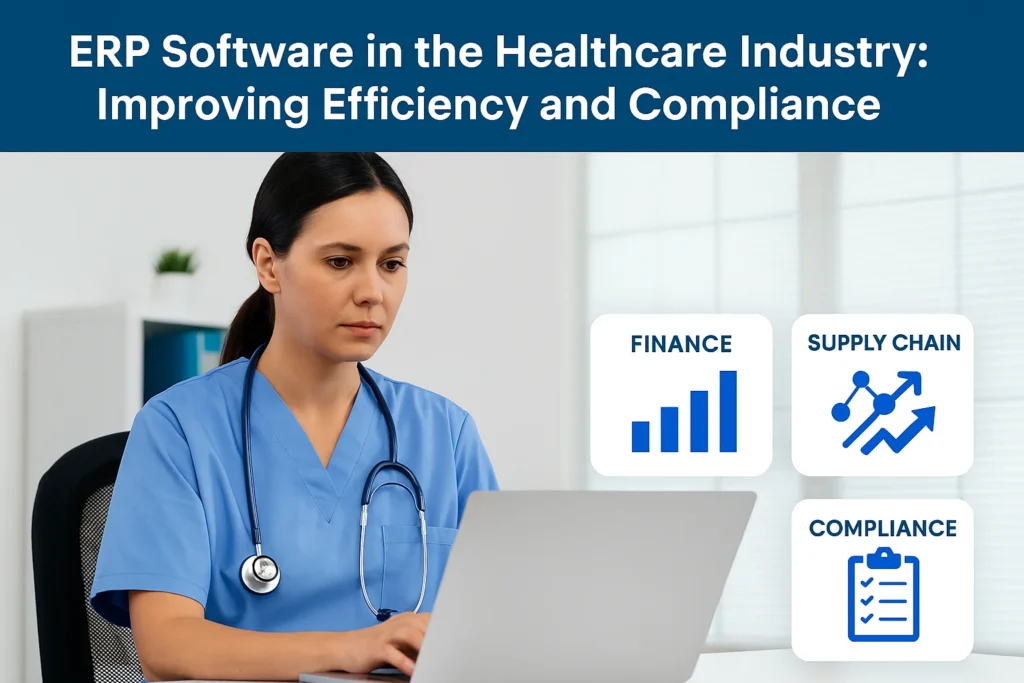

Hospitals, clinics, and diagnostic networks run on thousands of tiny decisions each day—from scheduling and admissions to purchasing and pharmacy replenishment. When those decisions are scattered across spreadsheets and legacy systems, delays creep in, costs swell, and compliance gaps appear. That is precisely where an integrated enterprise resource planning platform can change outcomes for patients and administrators alike.
This article examines how ERP Software can streamline operations in the healthcare industry without compromising safety or privacy. We will look at the modules that matter, the guardrails that keep data secure, and the integrations that bind finance, supply chain, and clinical operations together. You will also see a small case study that shows the measurable impact in the real world.
Why Healthcare Needs ERP Software
Healthcare organisations rely on consistent, repeatable processes: patient registration, bed management, billing, procurement, biomedical maintenance, and staff rostering. Each process influences cash flow and care quality. ERP software centralises these workflows so that a transaction in one department updates the books, the inventory, and the compliance log everywhere else.
- Single source of truth for finance, inventory, and human resources.
- Real-time visibility into occupancy, consumables, and vendor SLAs.
- Standardised approvals and audit trails, reducing manual errors.
- Better forecasting of demand, especially for critical drugs and disposables.
When the back office moves faster and more accurately, clinicians get what they need on time—and patients feel the difference.
Core Modules that Matter in Healthcare
Although clinical systems like EHRs and PACS deliver direct patient care, administrative strength comes from well-chosen ERP modules. The right combination eliminates duplicate entry and improves decision support for executives and ward managers.
- Financials and Revenue Cycle: General ledger, accounts payable/receivable, cost centres, and insurance reconciliation align services with revenue.
- Supply Chain and Procurement: Vendor catalogues, request-to-approve workflows, three-way matching, and contract pricing to lock in savings.
- Inventory and Pharmacy: Batch, lot, and serial tracking; FEFO/expiry control; formulary management; narcotics stock checks.
- Human Capital Management: Credentialing, shifts, overtime, and training records for clinicians and non-clinical staff.
- Asset and Maintenance: Biomedical equipment registers, preventive maintenance schedules, and downtime analytics.
- Analytics and Planning: Budgeting, rolling forecasts, and KPI dashboards for occupancy, ALOS, and theatre utilisation.
| Objective | What the Module Delivers | Typical Outcome |
|---|---|---|
| Faster billing | Integrated charges, codes, and approvals | Reduced days in A/R |
| Lower stockouts | Automated re-order points and FEFO | Fewer cancelled procedures |
| Cost transparency | Activity-based costing | Improved service line margins |
| Staff stability | Scheduling and credential alerts | Higher compliance, less overtime |
Do not assume you need every module on day one. Prioritise high-friction processes first—often revenue cycle and supply chain—and expand once adoption stabilises. A staged roll-out reduces disruption and concentrates training where it matters most.
ERP Software, Security, and Regulatory Compliance
Trust is the currency of healthcare. ERP Software must protect personally identifiable information and sensitive financial data, while leaving a trail robust enough for auditors. Start by establishing a least-privilege model with role-based access that maps to job functions such as cashier, pharmacist, or stores manager. Enforce strong authentication and keep administrative actions behind break-glass procedures.
Compliance frameworks vary by geography, but the principles rhyme. Encryption in transit and at rest, immutable logs, and time-stamped approvals are non-negotiable. Many hospitals also implement maker–checker workflows for procurement and payments. When supported natively in the ERP, those controls are easier to monitor and harder to bypass.
| Regulatory Area | ERP Control | Benefit |
|---|---|---|
| Privacy and consent | Role-based access, consent flags | Limits unnecessary data exposure |
| Pharmacy compliance | Batch/lot tracking, expiry locks | Prevents dispensing violations |
| Financial reporting | Segregation of duties, audit trails | Cleaner audits, fewer exceptions |
| Vendor governance | Approval workflows, vendor KYC | Lower fraud risk |
Finally, build a security cadence: quarterly access reviews, monthly vulnerability patching, and annual penetration testing. Document exceptions and remediation, and ensure that logs are retained per policy. Compliance is not a project milestone; it is a habit.
Interoperability: Connecting ERP with EHR, LIS, and PACS
ERP rarely exists alone in a hospital. It must exchange data with the electronic health record, laboratory information system, radiology/PACS, blood bank, and claims gateways. The ideal pattern is an API-first integration layer that publishes events—order placed, item issued, invoice posted—so downstream systems stay synchronised without brittle point-to-point scripts.
Common integrations include mapping patient visits to financial cost centres, syncing pharmacy issues to the EHR medication administration record, and pushing stores requisitions to suppliers via EDI. Where standards exist, use them: HL7 or FHIR for clinical context, GS1 barcodes for inventory, and ISO identifiers for locations. The payoff is fewer reconciliations and faster month-end close.
- Adopt a canonical data model for items, units of measure, and locations.
- Use message queues for resilience when clinical systems are intermittently offline.
- Maintain interface monitors so failures are surfaced before clinicians feel pain.
Inventory, Pharmacy, and Supply Chain Excellence
In healthcare, the supply chain is life-or-death. Expired items, missing implants, or late antibiotics create clinical and financial risk. An ERP-led supply chain disciplines purchasing and consumption while safeguarding patient safety.
Start with master data: item catalogue, formulary equivalence, units, and vendors. Add FEFO rules so expiring lots move first. Configure min–max levels per ward and theatre to reflect realistic consumption. For pharmacy, track controlled substances with cycle counts and dual verification. For implants and high-value consumables, implement serial tracking tied to the patient and procedure.
To reduce waste, pair demand forecasting with kits and preference cards. Theatre nurses can request a single kit for a procedure, while the ERP expands it into items for picking and post-op reconciliation. Analytics then highlight variance by surgeon or service line, driving negotiation with suppliers or changes to protocols.
Every prevented stockout protects a surgery; every avoided expiry protects the budget.
ROI, TCO, and a Practical Roadmap
Leaders often ask whether the investment is worth it. The answer is yes when you quantify both hard and soft benefits and connect them to clear milestones. Hard savings include purchase price variance reductions, lower carrying costs, fewer write-offs, and reduced overtime. Soft benefits show up as faster discharge billing, better vendor compliance, and higher staff satisfaction.
Build a five-quarter roadmap with phased releases. Phase one might stabilise financials and basic procurement. Phase two could expand to pharmacy and fixed assets. Phase three completes advanced analytics. Keep scope tight, with a visible backlog for future waves so departments see their needs are planned, not ignored.
Case Study: Sunrise Care Hospital. A 250-bed multi-specialty hospital implemented financials, procurement, and pharmacy in six months. Before ERP, stockouts affected seven percent of surgeries; expired items caused quarterly write-offs. After go-live, automated re-order points cut stockouts to 1.5 percent within two quarters, and pharmacy expiries dropped by forty percent. Invoice matching time fell from twelve days to four, improving vendor relationships and enabling early-payment discounts.
The leadership team attributes success to three habits: ruthless scope focus, weekly executive stand-ups, and transparent metrics displayed in wards and purchase offices. Nurses participated in designing kits and preference cards, which increased adoption and reduced post-op reconciliation time. When an integration outage briefly delayed pharmacy issues, the message queue buffered transactions and the monitor alerted IT before wards were affected. By the end of year one, the board approved the next wave covering fixed assets and maintenance.
- Define KPIs early: stockout rate, days in A/R, expired value, purchase price variance.
- Instrument the system with dashboards visible to clinical and administrative leads.
- Run monthly operational reviews to convert insights into actions.
To manage total cost of ownership, avoid unnecessary customisations inside the core. Extend via APIs and low-code apps for niche workflows. Train super users, document SOPs, and keep a testing playbook ready for each upgrade. Small habits compound into sustainable ROI.
Conclusion: Improving Efficiency and Compliance
Healthcare providers do not compete on paperwork; they compete on outcomes and experience. ERP Software is not a replacement for clinical systems, but it is the backbone that keeps finance, operations, and compliance aligned with the mission of care. When thoughtfully selected and implemented, it reduces waste, accelerates billing, and tightens audit readiness while making life easier for staff.
Choose modules deliberately, secure the environment by design, and integrate with the clinical stack through open standards. Start small, measure relentlessly, and keep stakeholders engaged through clear dashboards and change champions. Do this, and your organisation will see the two results that matter most: smoother operations for your teams and safer, timelier care for your patients.
Celebrate quick wins to sustain momentum across busy clinical teams everywhere.