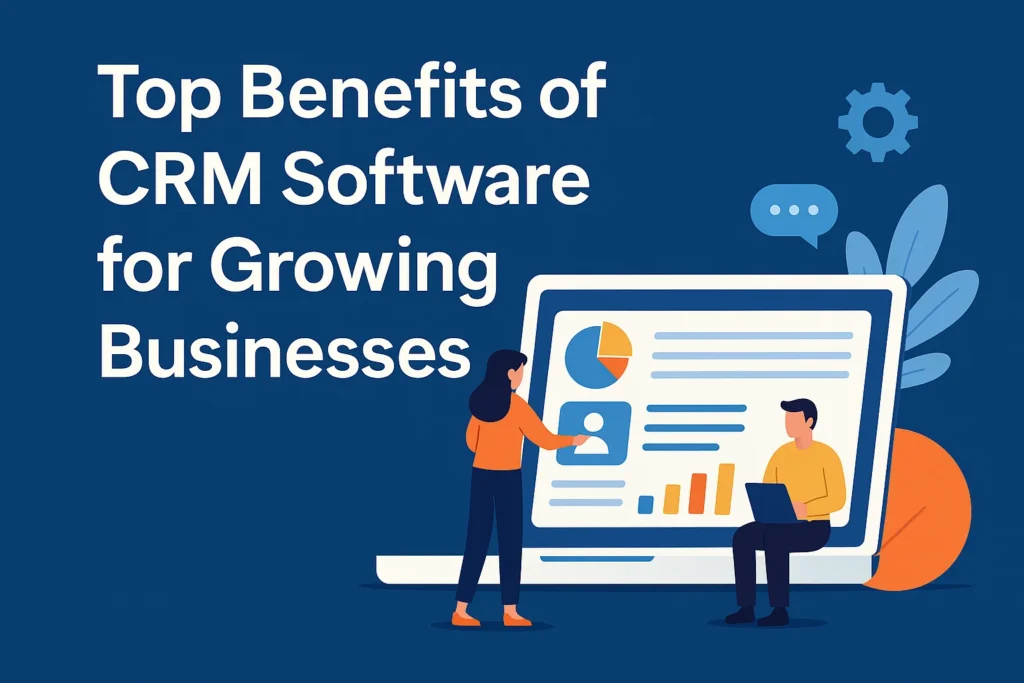

In today’s competitive marketplace, customer relationships are the foundation of long-term success. As businesses expand, managing those relationships becomes more complex, requiring streamlined systems and smarter strategies. That’s where Customer Relationship Management (CRM) software steps in. Designed to consolidate data, automate processes, and strengthen customer engagement, CRM solutions are becoming an essential tool for growing businesses of all sizes.
From small startups to mid-sized companies scaling operations, CRM software delivers measurable value. It allows businesses to go beyond simple contact management and instead focus on nurturing leads, understanding customer behavior, and driving consistent revenue growth. With the right CRM platform, a growing business can not only stay organized but also create lasting bonds with customers that foster loyalty and advocacy.
This article explores the top benefits of CRM software for growing businesses, supported with examples, insights, and comparisons to similar business management tools such as ERP Software. By the end, you’ll have a clear understanding of how CRM empowers organizations to scale with confidence and efficiency.
1. Centralized Data Management
One of the most powerful advantages of CRM software is its ability to centralize customer data in a single, accessible location. Rather than relying on scattered spreadsheets, outdated contact lists, or isolated sales notes, CRM creates a hub where all customer information is stored and updated in real-time.
- Improves team collaboration by providing a unified customer view.
- Reduces duplicate entries and data errors.
- Ensures that sales, marketing, and support teams work from the same source of truth.
“With CRM, every interaction becomes an opportunity to strengthen customer trust and deliver value.”
2. Enhanced Customer Engagement
CRM systems empower businesses to tailor communications and experiences to individual customers. By tracking purchase history, communication preferences, and feedback, businesses can deliver highly personalized engagement at scale.
For example, a growing eCommerce startup can use CRM to trigger automated follow-up emails after purchases, recommend complementary products, and send birthday discounts. This not only delights customers but also increases lifetime value.
3. Better Decision-Making with Analytics
Data-driven decision-making is a hallmark of successful businesses. CRM software provides powerful analytics and reporting tools that allow managers to track performance metrics such as lead conversion rates, customer acquisition costs, and sales cycle length.
Comparing CRM analytics with ERP Software reports highlights how CRM focuses on customers while ERP Software often focuses on back-office efficiency, finance, and operations. Both systems complement each other for holistic decision-making.
| Feature | CRM Software | ERP Software |
|---|---|---|
| Primary Focus | Customer Relationships & Sales | Operations, Finance & Inventory |
| Key Benefits | Engagement, Retention, Loyalty | Process Efficiency, Cost Control |
| Best For | Sales & Marketing Teams | Finance & Operations Teams |
4. Increased Sales and Lead Management
CRM tools streamline the sales process by automating lead tracking, scoring, and nurturing. Sales representatives no longer have to waste time guessing which leads are worth pursuing. Instead, the system provides insights into who is most likely to convert and when.
In addition, CRM platforms provide pipeline visibility so that managers can forecast revenue more accurately and identify bottlenecks in the sales cycle. These benefits directly translate into increased productivity and higher close rates.
5. Real-World Case Study: Local Retailer Transformation
A local fashion retailer, expanding into multiple cities, faced challenges in keeping track of its growing customer base. Without a proper system, customer complaints increased, and repeat business declined. After adopting CRM software, the company consolidated customer data, introduced loyalty programs, and implemented targeted promotions.
The results were striking:
- Customer retention increased by 35% within six months.
- Sales per customer rose due to personalized promotions.
- Customer satisfaction scores improved significantly.
This case demonstrates how even small, growing businesses can use CRM to achieve measurable gains in performance and customer satisfaction.
6. Streamlined Collaboration Across Teams
Growing businesses often struggle with siloed teams and disconnected communication. CRM software eliminates these issues by offering shared dashboards, task assignments, and activity tracking. Sales, marketing, and support departments can work cohesively, ensuring the customer journey remains smooth and uninterrupted.
Unlike ERP Software, which often focuses more on finance and logistics, CRM emphasizes collaboration around customer touchpoints, making it indispensable for relationship-driven growth.
7. Scalability and Future Growth
As a business grows, so too does the complexity of managing customer relationships. CRM software is built to scale alongside businesses, offering features such as AI-driven insights, mobile access, and integration with third-party apps.
Scalability ensures that a business never outgrows its CRM system. Whether adding new employees, expanding into new markets, or handling a larger customer base, CRM adapts to meet changing needs without compromising performance.
Conclusion
CRM software has emerged as a game-changer for growing businesses, offering centralized data management, better engagement, advanced analytics, and scalable solutions. When paired with ERP Software, companies gain a complete toolkit to manage both customer-facing and internal operations effectively.
For growing businesses, the benefits are clear: stronger relationships, smarter decisions, and sustained revenue growth. In an era where customer loyalty is the currency of success, CRM software is not just an option—it’s a necessity for businesses determined to thrive in competitive markets.